
Send in the terrorists!

I’ve spent numerous summers abroad and missed Canada Day (July 1st) probably close to a dozen times.  However, this year I felt particularly unpatriotic despite singing O Canada in the Union Oyster House with some random Canadians from Kingston who were in Boston for the weekend.  However, after spending a few days in Boston as a tourist, I couldn’t help but become ensconced in feelings of American patriotism, feeling proud of America and its accomplishments, and a deep sympathy for its fallen heros.
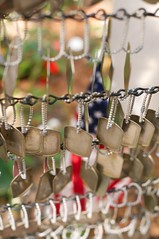
Part of a memorial for those killed in action in the wars in Afghanistan and Iraq. The memorial has one blank dog tag for each fallen American. They numbered 5400 when I visited.

Continue reading “Send in the terrorists!”

Scientific reporting in the popular media

Reporting of science in popular media such as newspapers and magazines is, in general, of dubious quality.  Journalists that report on science, it appears, need no understanding of science.  Causation and correlation; statistical significance and knowing something for certain; hype and expectation: in the minds of many journalists, these appear to be equivalent.  Can we blame them, though?  Even if a scientist’s work is faithfully reported, can we expect readers to keep these things separate?  Probably not, but the blame can then be placed on science education and perhaps a lack of space for an article.  Approaching an article on the effectiveness of the suicide barrier on the Bloor Viaduct in the on-line version of the Globe and Mail with my low expectations, I was very pleasantly surprised to find an embedded copy of the original report.  Kudos to the author, Anna Mehler Paperny, and kudos to the Globe.  I hope more organizations learn from this example.

Good presentations: Part II — Content or charisma?

When I first planned this blog post as a sequel to Part I, I had a different opinion of academic presentations than is presented here — the result of further pondering.

I’ve heard and read horror stories about the sinister slideshow spawn seen as a result of fancy presentation making software as a result of the temptation or perhaps desire to cripple content contained within a presentation.  How easy it is to mask the fact that the emperor has no clothes when all the razzle-dazzle one needs to misdirect and mislead an audience is available at the click of a button!  We hear about these things happening in the business world and the military.  If the PMO started using PowerPoints (or Keynotes or their brethren) to address the nation, you can bet it’d be happening there, too ((For now, politicians do not need it since they often possess the gift of the gab — oratory PowerPoint.)).  But is it happening in academia, a community that takes pride in its supposed openness and ability to challenge what it thinks it knows?  Are academics guilty of content concealment by PowerPoint?

Continue reading “Good presentations: Part II — Content or charisma?”

Good presentations: Part I — Fidgeting

When attending presentations, I seem to have one of two reactions. One is to become very drowsy. This is clearly a bad reaction. The other is to become fidgety. I suppose this is a bad thing from, too, but, at least in my case, I think it’s a good sign. Usually, the reason I become fidgety during presentations is because I feel inspired; such presentations make me want to go out and do something, not simply sit there. That’s a good presentation. So if you ever see me fidgeting during one of your presentations, take it as a compliment.

The trump argument

Last week, I heard about a certain intellectually precocious third-grader whose ability to make persuasive arguments as to what he should and should not be permitted to do sometimes consternated his parents.  I pressed further neither into the nature nor subject of the arguments, but I was told that his parents delivered a solid “no” on account of still having the emotional age of someone his age.  The parental trump card.  This got me thinking about those skeptical of (anthropogenic) climate change (cf. climate change denialists and cf. climate change skeptics).

Continue reading “The trump argument”

What keeps me up: Google Cloud Print

Google hopes to make printing from anywhere and any application — including “web apps” — simple using Google Cloud Print.  Printing from a browser typically includes many things that clutter the printout such as navigation bars and advertisements.  In the case of web applications, parts of the document may also be missing if scrolling is required.  Google Cloud Print promises to allow web applications such as Google Docs — or even conventional applications — to print “properly”.  Furthermore, Google will keep the software for your printer up to date (although you’ll still need to make sure the printer is properly configured to use Google Cloud Print).  Sounds like a good idea, doesn’t it?  Maybe on the surface.

Continue reading “What keeps me up: Google Cloud Print”

Peddling an idea

The Bill and Melinda Gates Foundation is a charitable organization that has laudable goals including improving healthcare and reducing extreme poverty.  One of its current fights recently suffered a setback when it was announced that a polio outbreak had struck Tajikistan, a place that had previously beaten back the disease.  With an infusion over the last two years of more than half a billion dollars and a world-wide expense of nearly $10 billion USD, polio has yet to be beaten.  Success in this campaign is far from guaranteed; so far, humanity has managed to use its skills to eradicate exactly one disease: smallpox.  Regardless of whether we manage to vanquish polio, we will certainly face other diseases.  Is there are more sure-fire way of saving lives?  Perhaps even one that could also help reduce poverty at the same time?

Continue reading “Peddling an idea”

Whither our weapons?

I sure hope the University of Toronto has a good supply of weapons, both melee and ranged.  A university probably ranks rather highly on a list of attack target for zombies — at least if they have any braaains.

Obscene scene modes

I don’t know how many of you own a digital camera, but they sure seem to come with a lot of “scene modes” nowadays.  You know the ones: portrait, dusk, backlit, night, sports, landscape, macro, indoor/party, fireworks, snow, beach…  but what if I want a night photo of fireworks at dusk on a beach such as seen in the Beaches in Toronto on Canada Day (assuming nobody is holding a strike)?  Okay, Mr. Smartypants, so the answer is you probably want “fireworks” mode, but while most people may find the decisions made by the fully automatic settings to be sufficient, sometimes additional human intelligence is required.

Obscene Scene Modes
Obscene Scene Modes

Continue reading “Obscene scene modes”